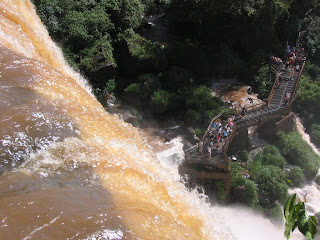
Taller than Niagara Falls, twice as wide with 275 cascades spread in a horsehoe shape over nearly two miles of the Iguazu River, Iguazú Falls are the result of a volcanic eruption which left yet another large crack in the earth. During the rainy season of November - March, the rate of flow of water going over the falls may reach 450,000 cubic feet (12,750 cubic m) per second.
These matter of fact details do nothing to describe the grandeur of the falls, the tremendous amount of water (an average of 553 cubic feet per second) thundering down 269 feet, the tropical location and the sheer beauty that led Eleanor Roosevelt to say Poor Niagara. Four times the width of Niagara Falls, Iguazu Falls are divided by various islands into separate waterfalls. One of the best known is Devil's Throat, or Gargantua del Diablo with its perpetual spray high over the falls. Other notable falls are the San Martin, Bossetti, and Bernabe Mendez.
Iguazú Falls, called Foz do Iguaçu in Brazilian, and Cataratas del Iguazú in Spanish, lie on the Argentina - Brazil border and are a UNESCO World Natural Heritage Site.
credited to gosouthamerica.about.com and flickr users: Oh_mon_heros!, keithhull, marc_shandro, ewanr, oceanbaby, hmlaplata, vtveen, c-weiss, claudio.ar, py_all, JO3P, dan-lem2001, phillie_casablanca, pics721, ewanembee, margeux2001